Justice For Our Women
Sentencing that reflects the lives lost.
We want the law and sentencing guidelines to end the current disparity in domestic homicide cases, ensuring murders committed in the home are treated with the same seriousness as all other homicides.
KW’s response to the Deputy Prime Minister’s announcement on sentencing
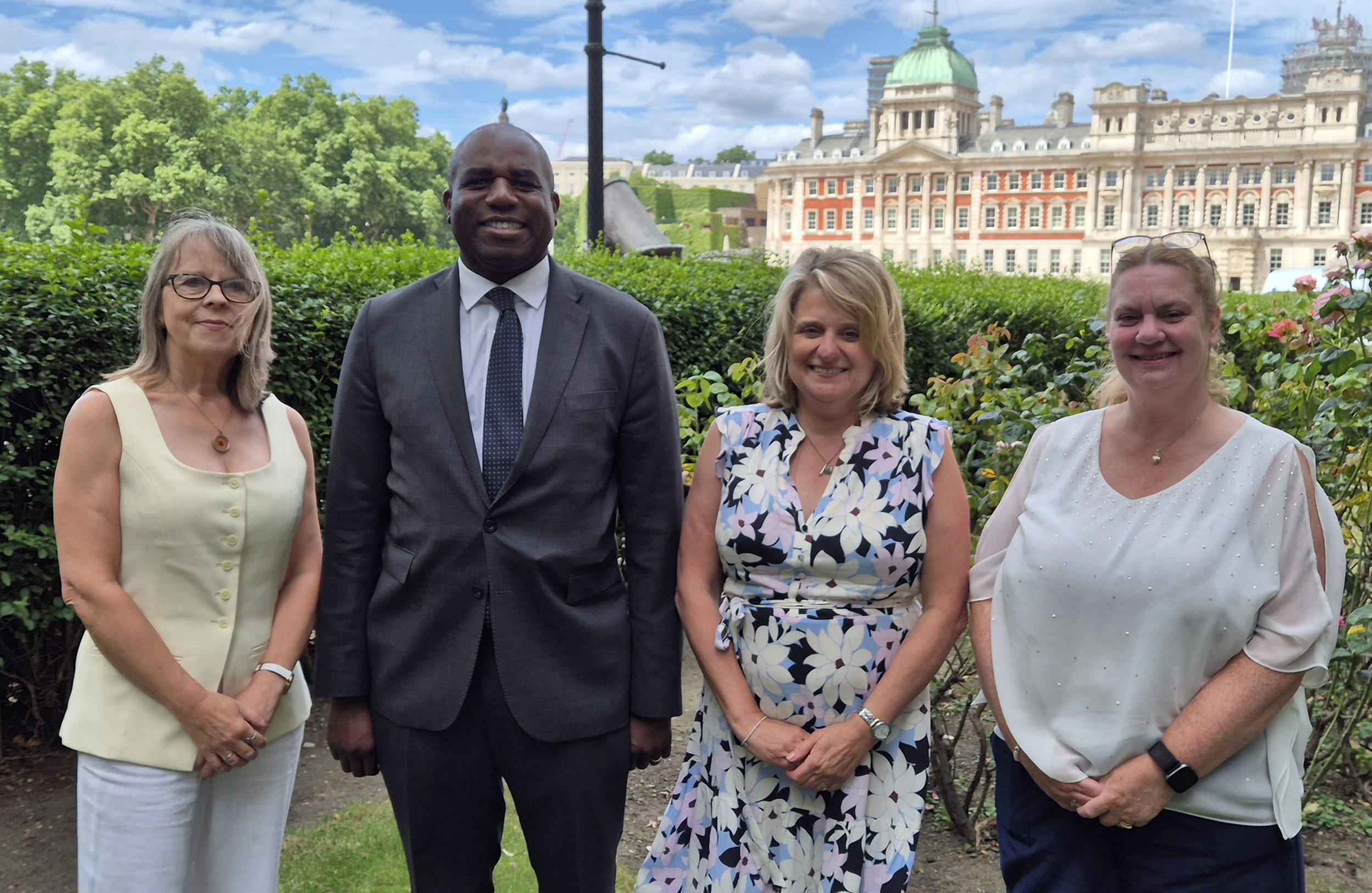
We, Carole Gould, Julie Devey and Elaine Newborough, the mothers of three young women brutally killed in their homes by former partners, thank the Lord Chancellor for announcing this important legal change, which finally aligns the starting point for murders committed in the home with those committed in the street.
At last, women’s lives are being valued as highly as men’s. Since around most 70 per cent of victims of homicide in the home are women, it has long been unjust that those who murder them routinely receive substantially lighter sentences simply because the murder weapon, such as a kitchen knife, was already there rather than brought to the scene.
We have been campaigning relentlessly on this issue for seven years, to persuade the State just how dangerous these men are. We have lost our daughters – Poppy, Ellie and Megan – to such men. Anyone who can murder someone they once loved – often the mother of their children – using such extreme violence is clearly a serious threat, not only to other women but to the public. We welcome the Government’s decision to keep these perpetrators in prison for longer, as an important step towards protecting women and to achieving their promise to halve violence against women and girls within a decade.
To make our case we have had many meetings in Parliament, with the VAWG sector and with those who work in Criminal Law. We feel that finally, after lots of heads being nodded and warm words spoken without action, we are seeing the fruits of our heartbreaking and unwanted labour. Over seven long years we have met with seven Lord Chancellors, each being sympathetic, but it is this Lord Chancellor, David Lammy MP, who has finally done the right thing. What drove us was knowing, categorically, that the current sentencing guidelines are wrong. Our daughters’ lives were taken in brutal ways, just as other women are killed every week inside their home, the place they were entitled to feel safe. The sentencing guidelines and statutory schedules failed to properly reflect this gross aggravating factor.
We therefore look forward to seeing the current minimum starting point of 15 years being raised to 25 years and being implemented in courtrooms as soon as possible. It is now time for judges to step up and fully recognise the dangerous nature of these murderers and to impose sentences that reflect the gravity of these crimes, in the interests of the public and of women all over the country, and in memory of our daughters – Poppy, Ellie and Megan.
Government Announcement: Domestic Killers to Face Longer Behind Bars
‘Heinous offenders who kill their partner, or ex, could face an additional 10 years in prison, under a change announced by the Deputy Prime Minister.
Under the current law, most domestic murders have a 15-year sentencing starting point, because they take place in the home with a weapon most likely already at the scene. However, for other murders where a weapon is taken to the scene with intent, the starting point is 25 years.
The Government announced [on 30 June 2026] that it intends to close this 10-year gap so that domestic murders are dealt with the same severity as other murders – regardless of whether they happen at home or anywhere else. Domestic murders are among the most devastating crimes and often represent a culmination of prolonged trauma and abuse.
Justice Secretary David Lammy:
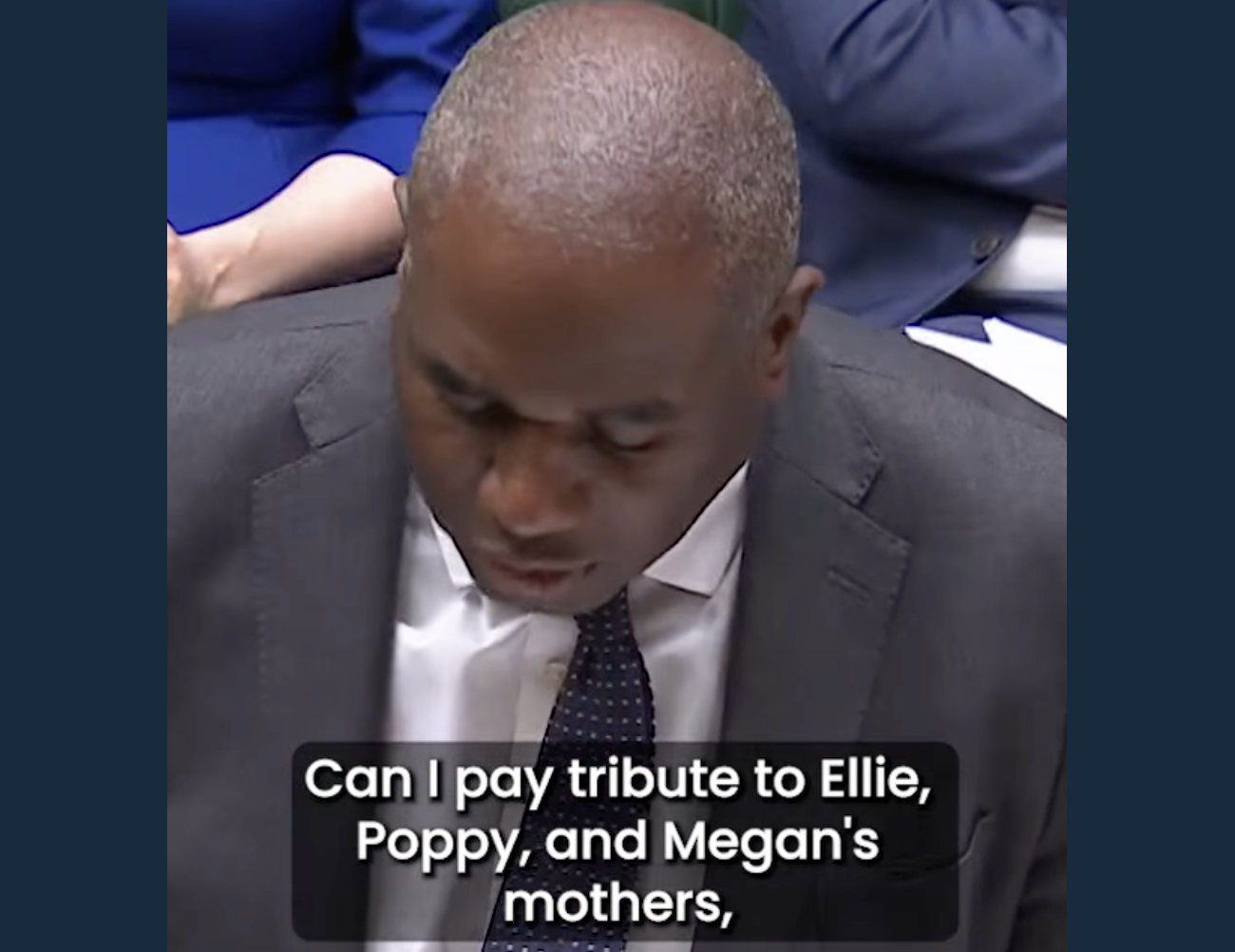
“For centuries, the law failed to protect women from violence at the hands of their partner – whether from marital rape or from abuse behind closed doors. Whilst we’ve made significant progress, we need to continue righting these wrongs. This change closes a long overdue gap and will ensure those who murder their partner face sentences that better reflect the devastating harm they cause.
I pay tribute to Carole Gould, Julie Devey and Elaine Newborough, whose courageous campaign will help future mothers, daughters and wives get the justice they deserve.”
More than a fifth of all murders are domestic, and overwhelmingly women are the victims in these cases. This change forms part of the Government’s commitment to halve Violence Against Women and Girls, and ensure swifter justice for victims and their families. The change will also include important safeguards to further protect victims. This means in cases where a victim of domestic abuse kills their abuser, the existing 15-year baseline starting point will still apply.
● This change to the law is subject to consultation with the Sentencing Council ● This measure will be introduced as soon as possible ● Further policy details, including the application to children who murder, will be outlined in due course ● The new starting point will apply to future murders after the date of implementation and will not be applied retrospectively ● This work is being conducted alongside the Law Commission’s review of homicide law and sentencing, to address the disparity as quickly as possible, ahead of the review’s conclusion in 2028.’
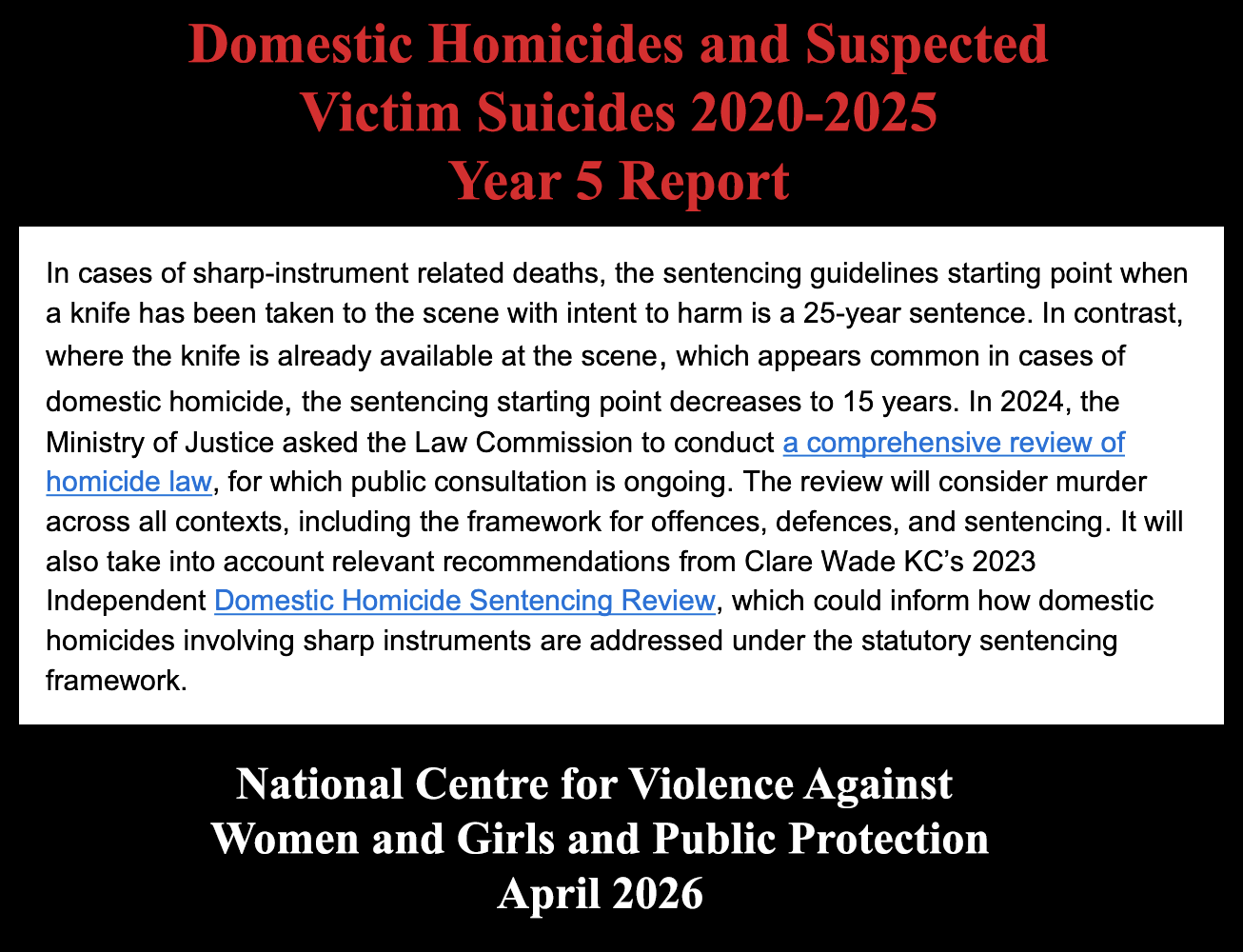
The NCVPP’s ‘Domestic Homicides and Suspected Victim Suicides Report Year 5’ refers (p. 22) to the ongoing review into sentencing being carried out by the Law Commission (like the Wade Review, commissioned by the government as a direct result of KW's campaigning).
KW co-founder Julie Devey OBE comments: “The Law Commission have now almost completed phase one, the Offences section. This will then be reviewed by the VAWG sector to give input. Then they will move through sections 2 and 3. Any recommendations will then be presented to the government. This process will take until 2030 – at the earliest. It is laborious. The 10-year disparity will stay in place all that time, and in the meantime approximately 400 women will be killed, around 75% of them most likely in their own homes.
The government need to act NOW, to show their commitment to keeping VAWG at the top of their agenda. The 15-year starting point could be changed even while the review is ongoing. We want to see this brought in line with the 25-year starting point, which would begin to show equal respect to those lives taken in a domestic setting, regardless of gender.
The government and judiciary must wake up and start sentencing these ‘domestic’ murderers in line with other murderers.”
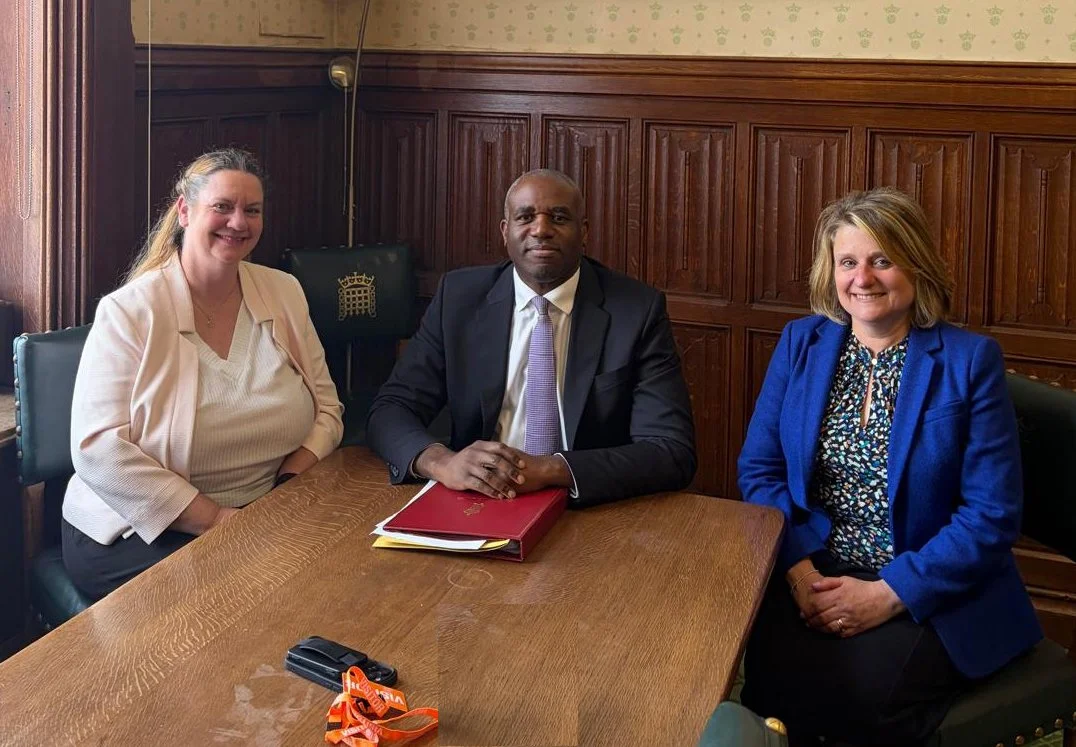
Carole Gould, Elaine Newborough and Julie Devey met on 22 April 2026 with Secretary of State for Justice David Lammy and Justice Minister Alex Davies-Jones for a useful – and hopefully productive – discussion on: ● the progress of sentencing reform; ● the take-up of aggravating factors when convicted domestic murderers are being sentenced; ● and the implementation of restrictive zones for offenders after their release.
● There is currently an unjustifiable 10-year disparity in the minimum tariff for life sentences for murder. For a murder committed when the weapon is ‘taken to the scene’ this is 25 years; for murder when the weapon is not deemed by the judge to have been ‘taken to the scene’, which seems to cover almost all murders committed within the victim’s home, and thus almost all domestic homicides, the victims of which are almost entirely women killed by men known to them (on average a shocking and unchanging 2 to 3 every week), this is just 15 years.
After years of both high-profile and behind-the-scenes campaigning by KW, different governments and ministers have promised change and instigated reviews. We pointed out that when reforms are announced but outcomes don’t alter, it demonstrates symbolic politics rather than real reform. Public trust is eroding because sentencing doesn’t reflect the seriousness of gender-based violence. This injustice needs to be changed NOW.
● The four key aggravating factors that now, after years of insistent campaigning by KW, should be taken into account at sentencing in domestic homicide cases are: history of controlling or coercive behaviour; use of sustained or excessive violence (‘overkill’); end of relationship/separation; and use of strangulation, suffocation or asphyxiation.
But these updates to the sentencing guidelines do not appear to be having the desired impact. KW presented Lammy with a list of a series of recent sentencings where the minimum term was still set at 15–16 years, with apparently little or no addition for the aggravating factors that were present in the various cases – although the judges were prepared to make reductions for guilty pleas (even when made at the very last moment, thus extending the anguish for the victims’ families) and for lack of previous convictions (although it beggars belief that this can be considered relevant once someone has committed the ultimate crime of murder). This is not good enough. It seems as though the judges need to be reminded (or educated) about the law – NOW.
● Last summer, the Government announced plans for the implementation of ‘Restriction zones’ to lock ‘the most serious sexual and violent offenders’ – not their victims – into specific areas after their release, allowing victims to travel anywhere else without fear of meeting their offender. KW urged Lammy to ensure that the wording will leave no grey areas, by specifically including murderers in the list of offenders to whom it will apply.

Killed Women’s Black & Blue Plaques: ‘Killed Here’ campaign, devised by Earnies and launched in September 2024, called on the new Labour Government to uphold the Conservatives’ commitment to change the outdated and misogynistic UK domestic homicide sentencing laws in support of murdered women and their families.
On average, in the UK perpetrators who kill in the home using a weapon kept in the home receive a sentence with a minimum prison term (starting tariff) before being considered for parole, of around ten years less than those killed out of home, due to out-of-date laws.
One woman is killed by a man every three days in the UK – and in most of these cases they are murdered by people they know, and the murders are generally horrific in nature and involve overkill. However, the final blow for families is often in the sentencing, when the criminal justice system deems their loved ones' lives are worth ten years less.
Killed Women called for Sir Keir Starmer and Shabana Mahmood, [then] Lord Chancellor, to urgently include this crucial issue in the Government’s agenda.
“We want the symbolism of these plaques to raise this issue in the House of Commons. The Government showed a refreshing approach to the riots this summer and we want this issue to be granted the same attention, in honouring the pledges made by the previous Government. While this won’t bring our loved ones home, at the very least, families of future victims will be consoled by the knowledge that justice has been served.”
Each bespoke Black & Blue Plaque includes the woman’s name, their life span, and then the words: ‘Killed here’, the sentence given, and ‘Murder is murder, change the law’.

Statement on Sentencing Reform
December 2024. Whilst Killed Women welcome the government’s proposed wholesale reform of sentencing for homicides, and we acknowledge that the implementation of statutory ‘aggravating factors’ for strangulation and ending a relationship is a step forward, we know from our own cases that these aggravating factors carry no significant weighting in sentencing – perhaps a year for each factor at most.
By only using the aggravating factor route to potentially harsher sentences, the government are continuing to say that domestic murderers ARE NOT as dangerous as those who murder strangers outside the home. During a recent meeting with Minister Alex Davies-Jones and Minister Sir Nic Dakin, we had the impression that they agreed with us that the two types of murderer were equally dangerous. The measures they are proposing today do not, however, reflect this.
It is therefore disappointing that the Government are delaying the equalisation of sentencing for homicides that take place in the home to be on a par with homicides in the street. The former disproportionally apply to women and, with all the rhetoric about halving violence against women and girls, it is hard to comprehend why the Government are not backing our campaign to put these dangerous offenders behind bars for longer. We believe that families should play a crucial role throughout the process of any changes being made to sentencing, as they know first-hand the impact and devastation that these murders create.
We understand the counter argument about not wanting women who have been victims of domestic violence to receive the same tougher sentencing if they become perpetrators, but in such cases these women should be exempted from the sentencing guidelines on the grounds of diminished responsibility or self defence.
This would require training for judges, barristers and police, for them to acquire a better understanding of why women kill, which would take only months rather than years. Once the judiciary have this deeper understanding, they will be better placed to inform juries, who have to consider evidence but do not have the tools to do so at present.
It is distressing for us to realise that, despite all the meetings and conversations that we have held over the past five years with both sides of the House, Domestic Murders are still not considered to have the same level of severity as murders by strangers.
The continued absence of any proper plan by the Government to tackle this inequality in sentencing is appalling. The fact that the Ministry of Justice continues to simply try to use aggravating factors to bring Domestic Homicides in line with other murders under the banner of “tougher sentences”, demonstrates that victims and victims’ families are not a priority for this Government.
We will continue to campaign on behalf of victims and their families to make the change that’s needed.
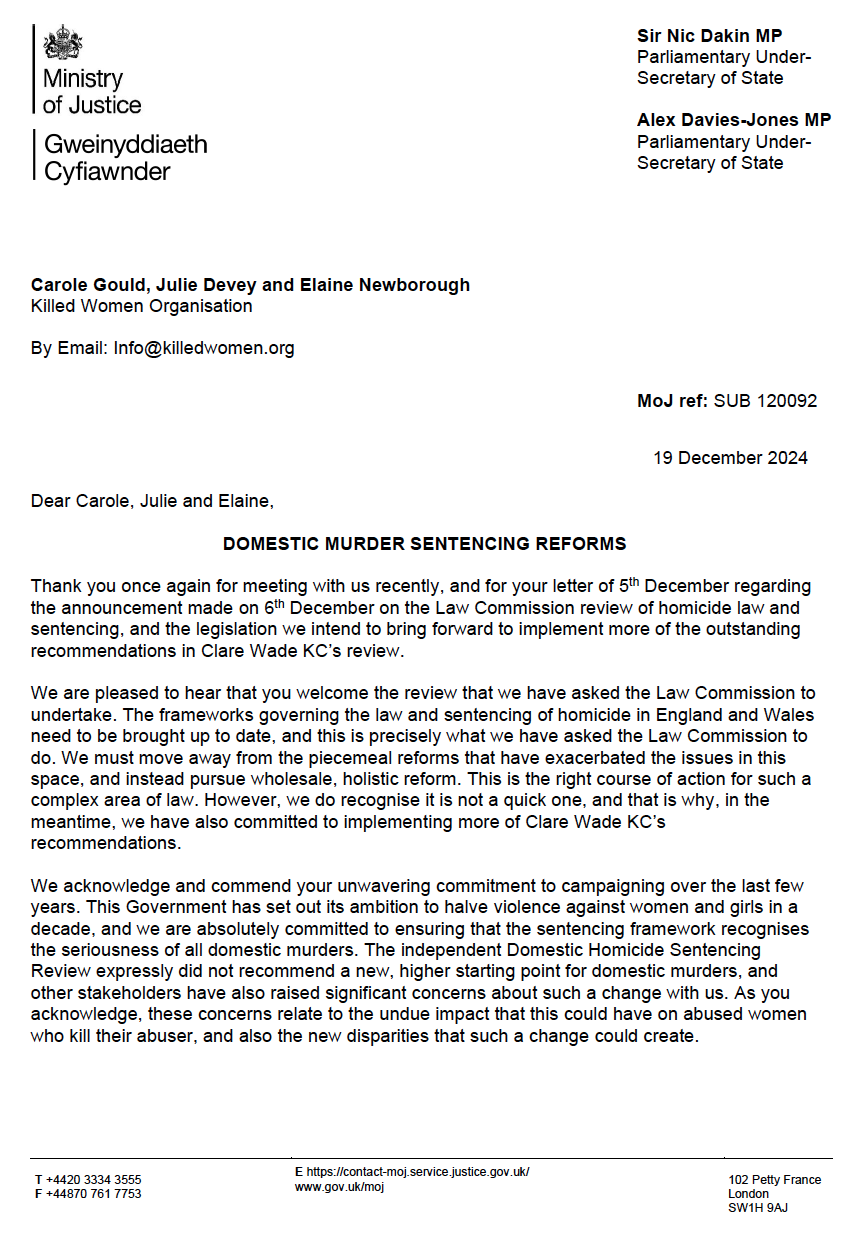
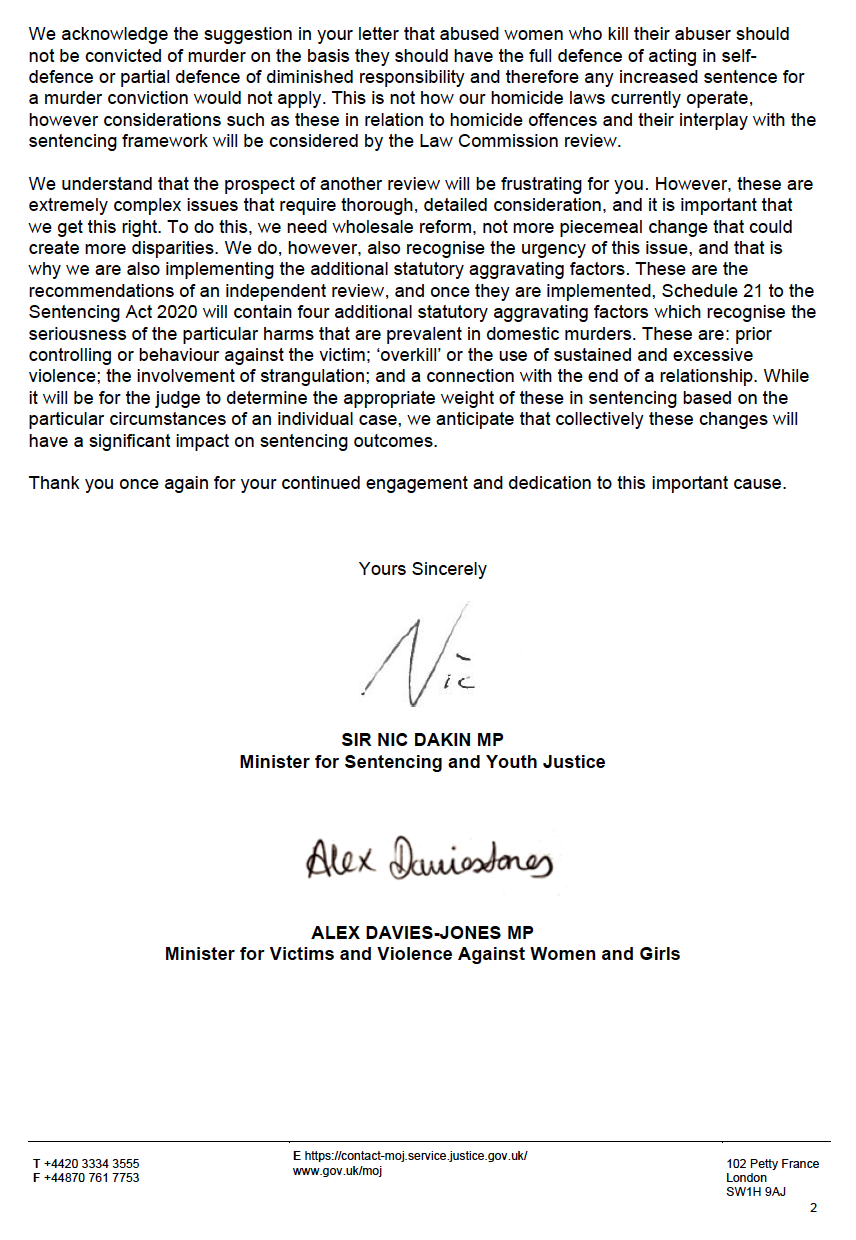

Murder Sentencing Consultation
This consultation, which was published by the Ministry of Justice as a result of Killed Women’s campaigning and meetings with ministers, and which closed on 4 March 2024, considered:
● raising starting points for killings with a history of coercive and controlling abuse or with a weapon;
● and whether murderers who use a knife or other weapon already at the crime scene should also face steeper starting points – which would result in higher minimum jail terms in these cases.
The Ministry of Justice then considered its response to the public consultation following 5,200 responses.
Julie Devey, Carole Gould and Elaine Newborough of Killed Women discuss these – and related – issues in a short film entitled ‘The Change That’s Needed’
These three mothers of Killed Women were interviewed by Julie Etchingham for ITV’s Tonight programme on Thursday 22 February 2024: ‘Murdered at Home’
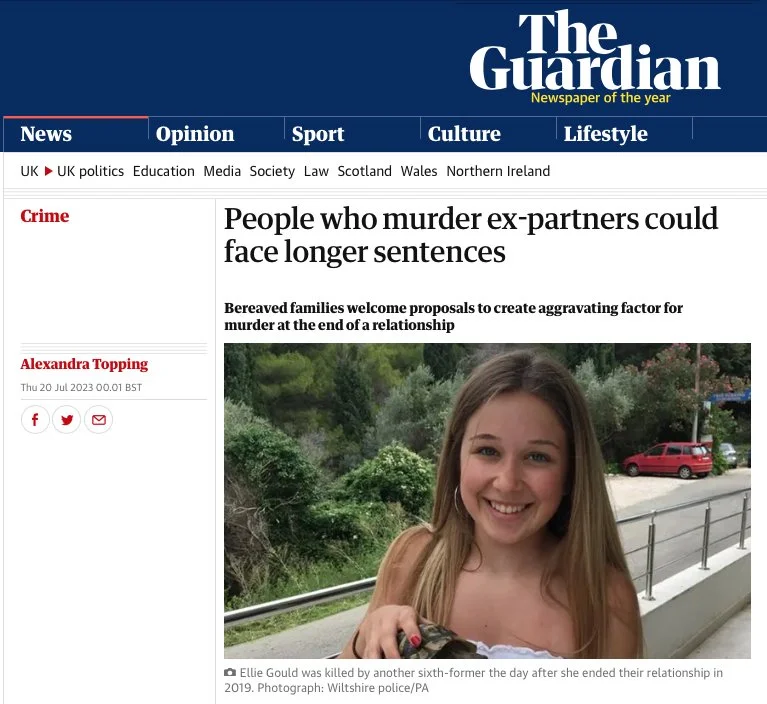
Dominic Raab to push for tougher minimum sentence in domestic homicides
As reported by Alexandra Topping in the Guardian, 17 March 2023:
‘Domestic abusers in England and Wales who kill their partners or ex-partners are to face tougher sentences under government plans after a campaign by bereaved families. The justice secretary and lord chancellor, Dominic Raab, will push for a change in the law after pressure from campaigners such as Julie Devey and Carole Gould, who have been calling since 2020 for a change to the minimum sentence for domestic homicide.
An independent review of domestic homicide sentencing published on Friday found that sentencing does not take into consideration the fact that many domestic murders happen after years of abuse. Under the plans, the law will be changed so a history of abusive, coercive or controlling behaviour against the victim or use of excessive violence, known as overkill, must be considered as aggravating factors in sentencing decisions for murder. Currently, a killer outside the home will face at least a decade more in prison than a domestic killer.
The justice minister, Edward Argar, paid tribute to Devey and Gould, who he said had “campaigned bravely and tirelessly” after the killing of their daughters. “No one should ever feel unsafe in their own home, and we will continue working with Julie and Carole and others to make further progress in tackling the dreadful crime of domestic abuse,” he said.’
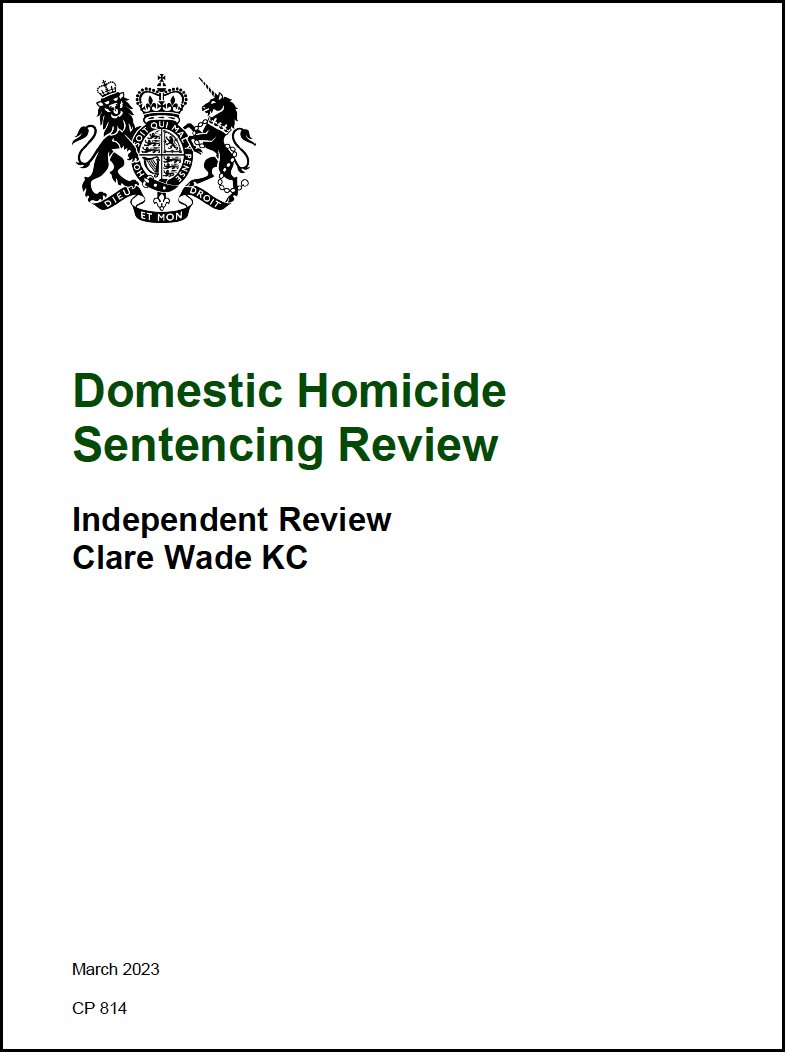
Domestic Homicide Sentencing Review
Following campaigning by Killed Women co-founders Carole Gould and Julie Devey, the government commissioned an independent expert, Clare Wade KC, to review sentencing in domestic homicide cases to establish whether current law and sentencing guidelines are fit for purpose and identify options for reform.
The Domestic Homicide Sentencing Review was published in March 2023 alongside a package of proposed reforms to change the law so that sentencing reflects the seriousness of domestic homicides. The government published a full response to the Review in summer 2023: https://assets.publishing.service.gov.uk/media/64b802acef537100147aeeee/domestic-homicide-sentencing-review-case-review-response.pdf.